
CELEBRITY
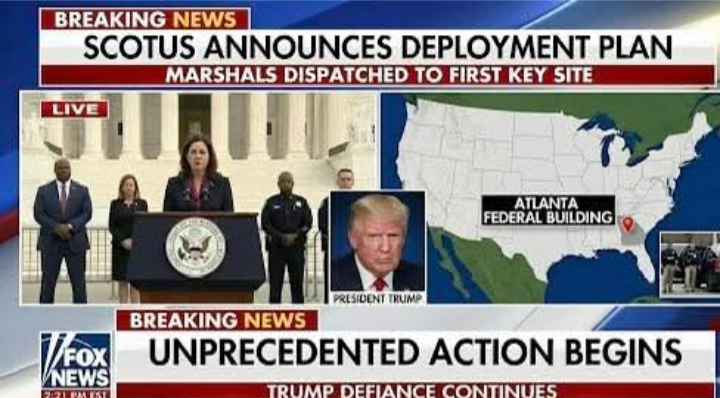
JUST IN: Supreme Court Mobilizes Federal Marshals Across the Nation to Enforce Lawful Court Orders After Donald Trump Repeatedly Rejects Judicial Directives, Signaling Unprecedented Step to Uphold Rule of Law

JUST IN: Supreme Court Mobilizes Federal Marshals Across the Nation to Enforce Lawful Court Orders After Donald Trump Repeatedly Rejects Judicial Directives, Signaling Unprecedented Step to Uphold Rule of Law
**Washington, D.C.** — In an extraordinary and highly consequential development, reports indicate that the U.S. Supreme Court has moved to mobilize federal marshals nationwide to ensure compliance with lawful court orders, following repeated instances in which former President Donald Trump allegedly rejected or ignored judicial directives.
According to sources familiar with the matter, the action reflects growing concern within the judiciary that its authority—and the broader rule of law—could be undermined if court orders are openly defied without consequence. The U.S. Marshals Service, which operates under the judicial branch when enforcing federal court mandates, is tasked with protecting the courts and executing their orders.
Legal scholars describe the reported move as rare and unprecedented in modern American history. While federal marshals routinely enforce court decisions, a nationwide mobilization tied to ongoing defiance by a prominent political figure would mark a significant escalation aimed at preserving judicial independence.
Supporters of the decision argue that the courts must act decisively to maintain credibility and constitutional balance, regardless of an individual’s political status. Critics, however, warn that such actions could further inflame political tensions and deepen national divisions.
Details remain limited, and neither the Supreme Court nor representatives for Trump have issued comprehensive public statements addressing the reports. As the situation develops, legal experts expect intense scrutiny over the scope of the marshals’ authority, potential enforcement mechanisms, and the broader implications for the separation of powers.
The coming days are likely to clarify whether this moment represents a turning point in the enforcement of judicial authority—or another flashpoint in an already polarized political landscape.

BREAKING: A PARENT’S HEARTBREAK: TATIANA SCHLOSSBERG’S PARENTS FINALLY SPEAK — AND WHAT THEY SHARED BROUGHT MILLIONS TO TEARS After a week of silence,

JUST IN: Jack Smith Gets FINAL REVENGE on T.r.u.m.p — Legal ENDGAME IGNITES in Washington

BREAKING: Trump IMPEACHMENT ALERT: Former Chief of Staff Mark Meadows Cooperates with Federal Prosecutors

BREAKING: White House Press Secretary Karoline Leavitt just dropped a political bombshell

BREAKING: A U.S. Senator. A Navy combat veteran. An astronaut. And a letter that has Washington buzzing. What happens when a decorated war hero reminds soldiers that their oath is to the Constitution—not to any one person?

BREAKING: U.S. Senator John Kennedy is now publicly demanding that Barack O.b.a.m.a return $120 million that he allegedly earned through ownership related to “Obamacare.”

TRUMP PANIC BOMBSHELL: T.R.U.M.P PANICS as MARK MEADOWS EVIDENCE GUARANTEES ARREST — Shocking Betrayal Rocks White House, Legal Storm Brews as Scandalous Revelations Threaten Imminent Downfall!

THE ULTIMATE LINE”: President Trump Issues Defiant Warning As Iran Is Drenched In Blood – The U.S. Will Not Stand By!

JUST IN: CONSTRUCTION WORKERS REMOVE T.R.U.M.P NAME from KENNEDY CENTER Seconds Ago — Legacy in Ruins as Backlash Boils, Political Enemies Cheer and Scandalous Motives Surface in Escalating Cultural Clash!

Trump PANICS as Congress DEMANDS RESIGNATION or IMPEACHMENT

BREAKING: T.R.U.M.P LOSES CONTROL OF MAR-A-LAGO AFTER COURT ORDER SHAKES HIS EMPIRE — Private power base rocked, inner circle scrambles, and a STUNNING LEGAL MOVE threatens to unravel the symbol of his dominance as pressure builds behind locked gates ⚡
