
CELEBRITY
BREAKING: The Supreme Court Issues Ruling Declaring Any Military Operation Against Greenland Without Explicit Congressional Authorization a Criminal Act, Warns Generals and Soldiers They Will Be Prosecuted for Following Illegal Donald Trump Orders

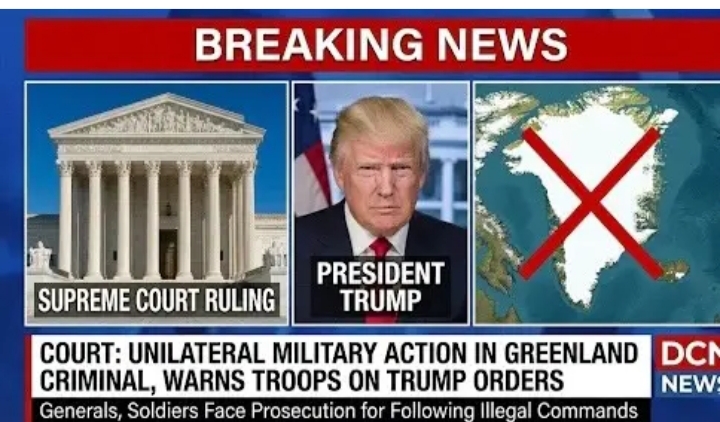
UPDATE: The Supreme Court Issues Ruling Declaring Any Military Operation Against Greenland Without Explicit Congressional Authorization a Criminal Act, Warns Generals and Soldiers They Will Be Prosecuted for Following Illegal Donald Trump Orders
**Washington, D.C. —** In a sweeping opinion released late Monday, the U.S. Supreme Court underscored the constitutional balance of war powers, holding that any significant military operation outside statutorily defined authorizations — including hypothetical actions against territory like Greenland — cannot proceed without explicit approval from Congress. Without directly naming specific future contingencies, the Court emphasized that the Framers entrusted the power to authorize war and major overseas engagements exclusively to the legislative branch.
The ruling comes amid heightened political controversy over recent U.S. military actions in Venezuela and escalating public debate about the presidency’s authority to unilaterally order forces into foreign territory. Several members of Congress have openly questioned the legality of such operations under the U.S. Constitution and the War Powers Resolution, which requires the president to seek approval from lawmakers for extended military actions. ([Congress.gov][1])
**Court’s Core Holding**
In the majority opinion — authored by Chief Justice — the Court held that while the president, as commander in chief, can direct routine military operations and respond to sudden attacks, “major military engagements affecting sovereign territory, absent specific legislative authorization, exceed executive authority.” The decision reinforced long‑standing legal principles that limit unilateral executive action in foreign conflicts and emphasized that even high‑ranking military officers must rely on lawful directives grounded in statute or congressional consent.
Justices in the majority stressed that constitutional and historic precedents, including early decisions limiting presidential overreach, require congressional authorization for actions that could meaningfully expand U.S. military involvement abroad. The Court did not categorically name countries or specifically address Greenland, but the language clearly signals that any contemplated operation “without express congressional approval” would lack legal foundation and could expose participants to liability.
**Warnings to Military Leadership**
In an unusually pointed passage, the Court reminded U.S. generals and commanding officers that their oath is to the Constitution, not to any individual political leader. The opinion states that knowingly carrying out an operation that courts have found unlawful would expose military personnel to potential criminal prosecution under the Uniform Code of Military Justice and U.S. criminal statutes. This provision drew both praise and criticism from legal experts, who noted its firm defense of constitutional checks and balances but warned of potential friction between civilian leadership and military command.
**Political and Legal Fallout**
The decision has already reverberated through Capitol Hill. A bipartisan group of senators is preparing legislation to clarify congressional authority over future U.S. military engagements. Some members say they will introduce a formal requirement that the president must obtain explicit authorization before initiating significant combat operations against foreign territory, including any hypothetical consideration of Greenland — a Danish autonomous territory that has been the subject of speculative political rhetoric.
In contrast, the White House pushed back against the decision, asserting that the Court’s ruling will not significantly hinder the president’s ability to protect national interests. The administration’s legal team argued that commanders in chief retain broad discretion to respond to national security threats, and that the decision merely affirms the constitutional architecture for major conflicts.
**Broader Constitutional Debate**
Legal scholars say the Supreme Court’s opinion revisits the perennial tension over war powers that has animated U.S. constitutional law for decades. Past cases have repeatedly tested the limits of executive authority in military affairs, and the latest ruling adds another chapter to an ongoing debate over how the United States should balance swift national defense measures with democratic accountability and legislative oversight.
Whether this decision will lead to concrete changes in how the United States conducts foreign military operations remains to be seen. But by reaffirming that Congress holds a central role in authorizing war and by warning military leaders against executing clearly unlawful orders, the Court has injected fresh urgency into an old constitutional question.

JUST IN: 10 MINUTES AGO: It’s OVER! SUPREME COURT Rejects Trump’s APPEAL — A 10-PAGE RULING Is ENFORCED Against Him!

BREAKING: POLITICAL EARTHQUAKE: Trump Faces Firestorm After Former General’s Explosive Accusation! ⚡ A stunning public claim by a former U.S. general has ignited outrage in Washington, triggering fierce reactions from lawmakers and voters alike. Trump is now on the defensive as the fallout escalates.

BREAKING: The Supreme Court Issues Ruling Declaring Any Military Operation Against Greenland Without Explicit Congressional Authorization a Criminal Act, Warns Generals and Soldiers They Will Be Prosecuted for Following Illegal Donald Trump Orders

1 Min Ago: A FEDERAL JUDGE Just Did What NO ONE Thought Possible to Trump — What He Said NEXT Left the Entire COURTROOM SILENT!

BREAKING: “WE’RE SCREWED!” — Trump PANICS on Truth Social over Supreme Court threat to his tariff power.

JUST IN: 40 mins AGO In an Unprecedented Decision, the United Nations Suspends the United States Under Article 5 After Condemning President Donald Trump’s Unilateral Military Action in Venezuela and the Capture of President Nicolás Maduro UN Makes Shock Move Against the U.S. After Venezuela Operation — What This Means for Global Power…Read Now watch what happens next..The story still unfolding

JUST IN: BOMBSHELL: GREENLAND SENATE PASSES HISTORIC LAW BANNING T.R.U.M.P FOR LIFE — Island Defiance Ignites Global Fury, White House in Meltdown as Diplomatic War Escalates and Secrets Unravel!

JUST IN : 30 MINS AGO Minnesota suing trump to block surge of immigration agents!

BREAKING CHAOS: Judge Rejects TRUMP’s Arguments as High-Stakes Asset Fight Explodes.

BREAKING: JUDGE ERUPTS: Trump DRAGGED FROM COURTROOM in SHOCKING MELTDOWN

BREAKING: Trump PANICS as IRS Allegedly Seizes Trump Tower Properties
