
CELEBRITY
BREAKING: The Senate has advanced a war powers resolution, which would block the president’s use of the U.S. armed forces to engage in hostilities within or against Venezuela unless authorized by Congress.

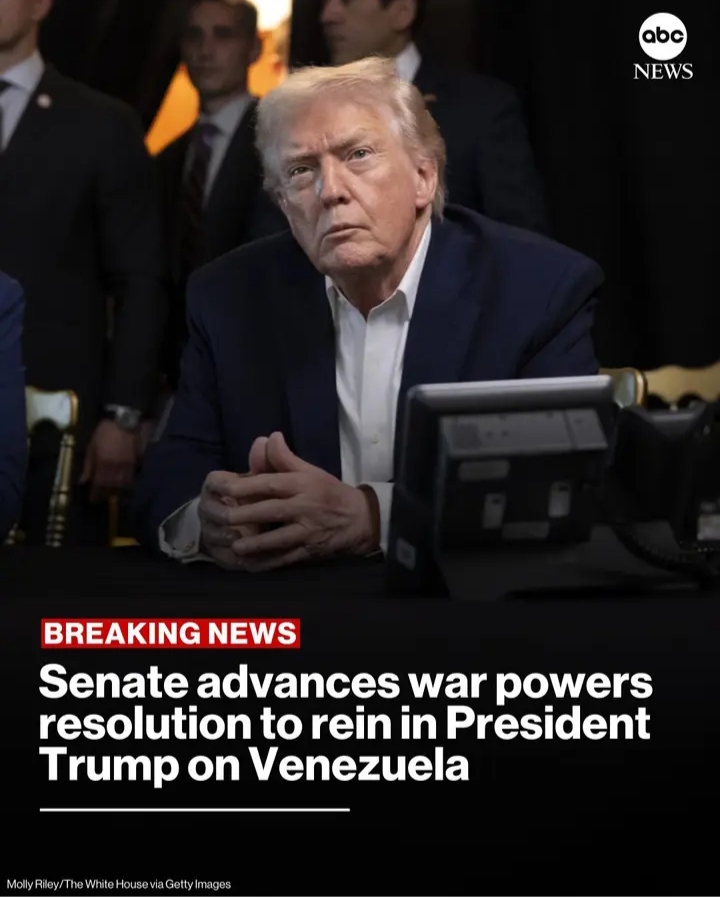
BREAKING: The Senate has advanced a war powers resolution, which would block the president’s use of the U.S. armed forces to engage in hostilities within or against Venezuela unless authorized by Congress.
The legislation, if finally approved by the Senate, would still need to be approved by the House and signed by the president. The bill did not pass the Senate with a veto-proof majority and it seems unlikely that Trump would sign it into law.
A small group of Senate Republicans joined with all Democrats to narrowly advance the resolution by a vote of 52-47. It needed 51 votes to move forward.
The U.S. Senate on Thursday took a rare step to check presidential authority on military action by advancing a war powers resolution aimed at restricting President Donald Trump’s ability to engage U.S. armed forces in hostilities within or against Venezuela without explicit congressional approval.
The procedural vote to move the resolution forward passed narrowly **52‑47**, with **five Republican senators joining all Senate Democrats** in support. The measure now heads toward a full Senate vote on final passage, though it still requires approval by the Republican‑controlled House and the president’s signature to become law—a prospect widely viewed as unlikely.
The resolution, backed by Democratic Sen. Tim Kaine (D‑Va.) and co‑sponsored by Republicans including Sens. Rand Paul (R‑Ky.), Lisa Murkowski (R‑Alaska) and Susan Collins (R‑Maine), would bar further U.S. military action targeting Venezuela unless **Congress specifically authorizes it**. Proponents argue it is needed to uphold the Constitution’s allocation of war powers and respond to growing concern over unilateral executive military decisions.
The move follows increased U.S. military involvement in Venezuela, including a recent operation that captured Venezuelan President Nicolás Maduro—an action that sparked bipartisan unease on Capitol Hill. Critics of the administration’s strategy say lawmakers were not adequately informed beforehand and that further action could embroil the U.S. in an open‑ended conflict.
Administration officials, however, have pushed back, with allies of the president characterizing the resolution as weakening national security and eroding the commander‑in‑chief’s authority. The White House has signaled that the president will likely veto the measure if it reaches his desk.
Even if vetoed, the Senate’s vote marks a significant bipartisan rebuke and underscores growing congressional scrutiny of foreign military engagements that do not have prior legislative approval.

BREAKING: TRUMP ERUPTS After BARACK OBAMA DESTROYS Him LIVE ON TV — ON-AIR REBUKE TRIGGERS TOTAL MELTDOWN

BREAKING: As the curtain falls on a public fallout that’s gripped global attention, here’s how the key players sounded today—sharp words, mixed signals, and no shortage of drama. Donald Trump is reportedly considering selling his Tesla, per CBS. Talk of a possible call with Elon Musk fizzled fast after Trump said he had no interest in speaking to “the man who has lost his mind.”

JUST IN: 40 minutes ago: BREAKING — Reports say panic is spreading across Congress as multiple members meet behind closed doors, urgently trying to wipe digital footprints. The scramble follows claims that Jack Smith uploaded subpoenaed phone records tied to calls from Donald Trump during efforts to delay the 2020 certification. Sources warn the records may reveal coordinated actions at the highest levels. As the files circulate, Washington is on edge—and pressure is rapidly escalating.

BREAKING: The Washington National Opera Is Leaving the Kennedy Center After 55 Years Because of Donald Trump, After He Installed Himself as Chairman, Put Ric Grenell in Charge, and Renamed the Building. Obama Reacts to the News and Reveals Plans for a New Center, Naming It the Obama Biden Performing Arts Center, Causing an Uproar, as Many Artists Begin to Support the Idea and Want to Perform There — But What Shocked America the Most Is Not Only Trump’s Reaction to the Washington National Opera Leaving, but His Furious Five-Word Response to the Obama Biden New Center, Leaving Americans Asking Why Trump Is

30 minutes ago: BREAKING — The Washington National 0peral has announced it is leaving the Kennedy center after 55 years, citing upheaval following Donald Trump installing himself as chairman, placing Ric Grenell in charge, and renaming the venue. Barack obama responded by unveiling plans for a new Obama–Biden Performing rts Center, sparking an artistic revolt. Yet what stunned the nation most was Trump’s furious five-word reaction, now igniting ridicule, backlash, and nonstop debate.

BREAKING: The Washington National Opera just ABANDONED the Kennedy Center after FIVE DECADES, in response to Trump’s disastrous takeover of the center and the country.

BREAKING: A DECORATED WAR HERO AND SITTING U.S. SENATOR WAS JUST THREATENED WITH EXECUTION AND A MILITARY COURT-MARTIAL FOR TELLING SOLDIERS TO FOLLOW THE LAW.

📺 ABC Viewers Turn on Jimmy Kimmel After One Chilling Line About T.r.u.m.p and ICE A single moment from Jimmy Kimmel’s latest monologue has set the internet on fire — and ABC viewers are not holding back. After making a startling claim involving D.o.n.a.l.d T.ru.m.p and ICE, the late-night host left many watching in stunned silence, while others rushed online to accuse him of crossing a dangerous line. What exactly did Kimmel say… and why did it trigger such an intense backlash? The segment is now being replayed, dissected, and fiercely debated, as critics warn it went far beyond comedy — and supporters argue it exposed something much deeper. One thing is certain: this was not an ordinary late-night joke. 👇👇👇 Full story below

BREAKING: The GoFundMe page for Renée Good’s widow and family blows past its $50k goal to top $1.5 million in a few short days as support pours in from compassionate Americans.

BREAKING: A newly released video from Minneapolis shows an ICE agent shooting and killing a U.S. citizen—despite clear footage indicating the woman posed no danger to the agents on the scene. As the video spreads, outrage is growing, with critics asking how an agency tasked with enforcement crossed a line so deadly. For many, this isn’t just misconduct—it’s a warning sign.

BREAKING:Mike Pence says the White House’s handling of January 6 messaging is not just wrong — it’s offensive to the people footing the bill. With trust in institutions already fragile, the backlash suggests that Americans are watching closely when government platforms are used to tell politically charged stories.
