
CELEBRITY
JUST IN: Supreme Court Blocks President Donald Trump from Taking Any Further Military Action in Venezuela Without Explicit Approval from Congress, Ordering an Immediate Freeze on Resource and Oil Exploitation Plans

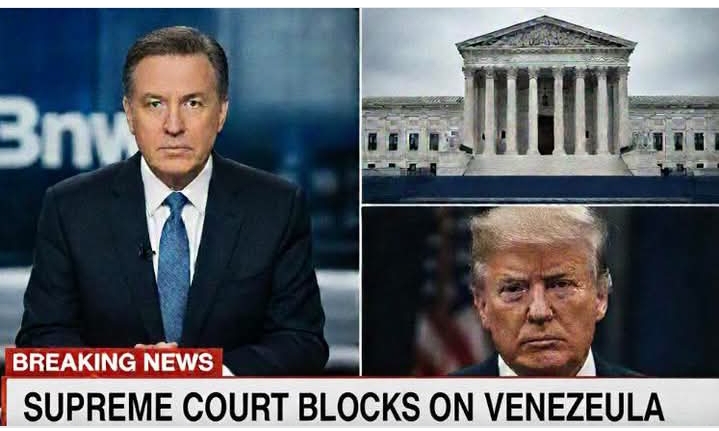
JUST IN: Supreme Court Blocks President Donald Trump from Taking Any Further Military Action in Venezuela Without Explicit Approval from Congress, Ordering an Immediate Freeze on Resource and Oil Exploitation Plans
In a historic ruling that sharply constrains presidential war powers, the **U.S. Supreme Court** today blocked President Donald Trump from undertaking any further military action in **Venezuela** without clear, explicit approval from **Congress**, and ordered an immediate freeze on all plans related to U.S. exploitation of Venezuelan resources, including oil.
According to the decision, which departed from decades of executive branch latitude in foreign engagements, the Court held that the Constitution grants **Congress — not the president — the authority to declare war and authorize military interventions abroad**. The ruling also emphasized that actions involving a nation’s sovereign resources, such as oil and minerals, require legislative oversight and authorization.
> *“The President may not unilaterally commit the United States to hostilities or to the control or extraction of another nation’s natural resources without a clear act of Congress,”* the opinion stated.
The decision came amid intense political friction over U.S. military involvement in Venezuela, where Trump’s administration launched a controversial operation in early January that resulted in the **capture of Venezuelan President Nicolás Maduro** and his transfer to the United States. The intervention drew sharp condemnation from lawmakers of both parties who argued that it lacked legal basis and violated constitutional war powers norms.([Reuters][1])
#### **Congress Pushes Back**
Earlier this week, the **U.S. Senate voted 52–47** to advance a **War Powers Resolution** designed to limit the president’s ability to conduct further military operations in Venezuela without congressional authorization. A bipartisan group of lawmakers, including five Republicans, sided with Democrats in pushing the measure forward, reflecting deep unease over the administration’s actions.
Senators backing the resolution underscored that the Constitution explicitly vests war-declaring powers in Congress — a check they said had been repeatedly bypassed in the recent campaign against Venezuelan leadership and infrastructure. Critics of the president’s approach argue that the U.S. raid on Caracas and subsequent moves toward asserting control over Venezuelan oil fields risk a broader conflict and potentially unlawful seizure of another country’s assets.
President Trump has defended his strategy as necessary for national security and combating drug trafficking and corruption, but the escalating legislative pushback — now culminating in the Supreme Court’s intervention — suggests a significant reassertion of constitutional checks on executive military authority.
#### **Impact on U.S.–Venezuela Relations**
If upheld, the Court’s directive would effectively halt any further U.S. military engagement in Venezuela until Congress acts. It would also require the Trump administration to suspend ongoing or planned efforts to develop or exploit Venezuela’s vast oil reserves, dealing a blow to strategic economic plans tied to the intervention.
Political analysts say the ruling could have far-reaching implications for U.S. foreign policy, particularly in cases where the White House seeks to expand military commitments without broad legislative support.

BREAKING: A law firm in Minnesota vows its lawyers will make Minneapolis the richest city in America suing “every single ICE agent who violates a Constitutional right, assaults a citizen, makes an unwarranted arrest, uses excessive force, or refuses to self-identify.”

JUST IN: Donald Trump says he regrets not ordering the National Guard to seize voting machines after losing the 2020 election.

JUST IN: Donald Trump Warns NATO That Continued Opposition to U.S. Greenland Ambitions Could Force America to Withdraw Troops, Cut All Funding, and Potentially Leave the Alliance Entirely, Sending Shockwaves Through Transatlantic Relations

JUST IN: Republican Senator Thom Tillis announced that he will be blocking all future Federal Reserve nominations put forth by Donald Trump because of the investigation into Jerome Powell.

BREAKING: Powell basically said the quiet part out loud: the Trump admin’s push to control the Fed is built on false pretenses. The Fed is meant to be independent so politicians can’t game the economy. Losing that independence would be bad news.

JUST IN: Democrat Mary Peltola, the 1st Alaska Native in Congress, has announced her campaign for the U.S. Senate. Democrats just struck a diamond mine with her….

JUST IN: President Trump just tried to publicly intimidate the Chair of the Federal Reserve and in doing so, he accidentally reminded America why the Fed exists, inadvertently turning its chair into a quiet institutional hero.

BREAKING: Remember when Jerome Powell corrected Trump’s math on national television, live, and called out his disinformation. Trump is still holding a grudge Jerome Powell just torched Donald Trump after the DOJ opened an investigation into Powell. Everyone needs to see this….

BREAKING: President T.r.u.m.p.’s voice boomed across a packed White House briefing room, eyes gleaming with triumph: “Canada has 30 days to tear down every barrier—or CUSMA dies, and their economy with it.”

JUST IN: FEDS OPEN CRIMINAL PROBE INTO POWELL AS TRUMP–FED WAR ESCALATES

BREAKING: DENMARK & GREENLAND TO HOLD TALKS WITH U.S. Denmark and Greenland will meet with U.S. officials this Wednesday, and while the agenda isn’t public, the stakes almost certainly are.
