
NEWS
The best witness for the never-completed prosecution of President Trump, it turned out, was the prosecutor himself: Jack Smith. Last week, the House Judiciary Committee released the transcript and video of Smith’s deposition, which is a stark reminder of the cost of letting Trump go unpunished and the danger of the President’s revenge-seeking against those who sought to hold him to account.

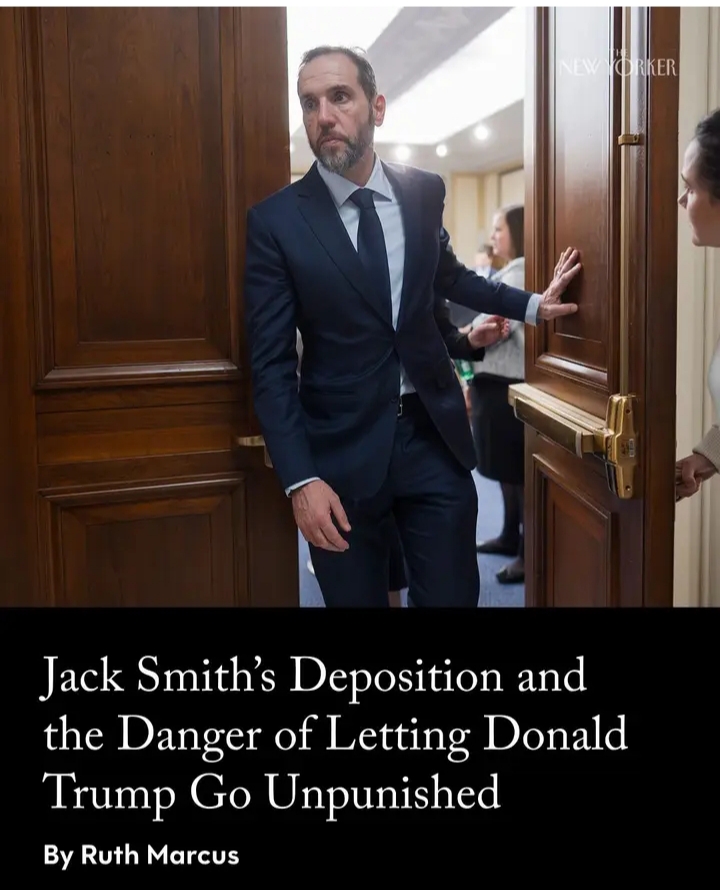
The best witness for the never-completed prosecution of President Trump, it turned out, was the prosecutor himself: Jack Smith. Last week, the House Judiciary Committee released the transcript and video of Smith’s deposition, which is a stark reminder of the cost of letting Trump go unpunished and the danger of the President’s revenge-seeking against those who sought to hold him to account.
“Smith’s deposition was, in all likelihood, as close as he will get to making a closing argument,” Ruth Marcus writes. “It marks, most likely, the unsatisfying conclusion of an unsatisfying episode, one that underscored the limitations of the criminal-justice system in dealing with a lawless President.” Now, with Trump calling Smith a “criminal” who should be “investigated and put in prison,” one question is the jeopardy that Smith himself may face. “I am eyes wide open that this President will seek retribution against me if he can,” Smith said at one point in the deposition. Still, he said, of his testimony before the committee, “I came here. I was asked to come here.” Read more:
The most compelling witness in the unfinished prosecution of President Donald Trump was not a former aide or an insider—it was the prosecutor himself. The release last week of the House Judiciary Committee’s transcript and video of Special Counsel Jack Smith’s deposition offers a sobering look at how the effort to hold a former president criminally accountable ultimately stalled, and at the personal risks faced by those who pursued it.
In his testimony, Smith methodically defended the integrity and necessity of the investigations he led, effectively delivering what amounts to a closing argument that never reached a jury. As columnist Ruth Marcus observed, the deposition may be the closest Smith will come to that moment, marking an unsatisfying end to an episode that exposed the limits of the criminal-justice system when confronted with a defiant and powerful president.
Those limits are now compounded by the political aftermath. Trump has publicly labeled Smith a “criminal” and called for him to be investigated and imprisoned, language that underscores the former president’s willingness to seek retribution against perceived enemies. Smith acknowledged that danger plainly during the deposition, stating that he was “eyes wide open” to the possibility of retaliation, yet emphasizing that he testified simply because he was asked to do so.
The exchange leaves behind more questions than answers—not only about accountability for presidential misconduct, but about the future of those tasked with enforcing the law. Smith’s calm, procedural testimony stands in contrast to the fury surrounding it, serving as a reminder that while the case may be over, its implications for justice, power, and personal risk are far from settled.

BREAKING NEWS: Trump Faces Possible Jail as Congress Unveils Seven Articles of Impeachment, Triggering One of the Most Consequential Political and Legal Showdowns in Modern U.S. History, While Multiple Criminal Investigations Expand, Tightening the Legal Net and Raising the Prospect of Real Crim.inal Charges Full story in comments 👇

BREAKING: The Senate has advanced a war powers resolution, which would block the president’s use of the U.S. armed forces to engage in hostilities within or against Venezuela unless authorized by Congress.

BREAKING: Congress may force President Trump to resign before March 31, echoing the historic fall of Richard Nixon. Lawmakers are weighing unprecedented legal and political pressure as investigations into allegations that Trump stole $3 billion from the American people continue. Political analysts say the unfolding situation could be one of the most consequential presidential crises in U.S. history, raising questions about accountability at the highest levels of government.

BREAKING: 40 mins Ago Minneapolis Mayor Jacob Frey responds to criticism over his comment that ICE should get the f* out of Minneapolis after an agent fatally shot a woman. But Frey didn’t walk it back. Instead, he doubled down—issuing a sharp, provocative warning that many are interpreting as a direct challenge to Donald Trump, further fueling political tension and national outrage…

JUST IN: Iranian Supreme Leader Khamenei says “Trump should focus on running his own country. Iran will not back down.”

JUST IN: Iranian Supreme Leader Khamenei says “Trump should focus on running his own country. Iran will not back down.”

BREAKING: After That Closed-Door Deposition, Everything Changed for Trump” What was said behind closed doors may be Trump’s biggest nightmare yet. Watch what they didn’t want the public to hear.

JUST IN; 40 mins Ago Taylor Swift Slams Donald Trump Over “Misleading Narrative” Following Fatal Shooting of U.S. Citizen Renee Nicole Good During ICE Operation Involving 2,000 Federal Agents in Minneapolis Minnesota

BREAKING: The ICE agent who shot and killed Renee Good in broad daylight has been identified as Jonathan Ross by the Minnesota Star Tribune. I think today is a great day for Jonathan to be indicted!

JUST IN: Supreme Court Decision Sparks Fresh Impeachment Fears for Trump
