
CELEBRITY
🇨🇳🇺🇸 CHINA WARNS THE UNITED STATES “If you want war, you will get war; if you want to destroy China, you will be destroyed. China will not fire the first shot, but China will not allow you to fire the second shot” One statement. Two superpowers. Infinite consequences. Stay informed—what happens next affects the world…..⤵️ — Victor Gao, President of China Energy Security Institute

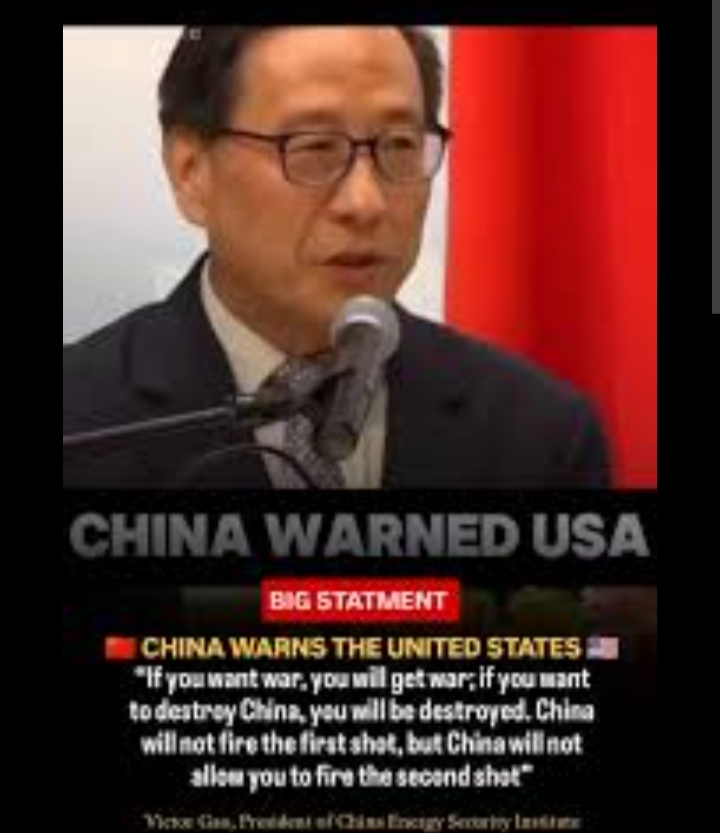
🇨🇳🇺🇸 CHINA WARNS THE UNITED STATES
“If you want war, you will get war; if you want to destroy China, you will be destroyed. China will not fire the first shot, but China will not allow you to fire the second shot”
One statement. Two superpowers. Infinite consequences.
Stay informed—what happens next affects the world
— Victor Gao, President of China Energy Security Institute
A stark warning attributed to Victor Gao, President of the China Energy Security Institute, has captured international attention: *“If you want war, you will get war; if you want to destroy China, you will be destroyed. China will not fire the first shot, but China will not allow you to fire the second shot.”*
One statement. Two superpowers. Infinite consequences.
The message reflects the growing tension between China and the United States, shaped by strategic rivalry, military posturing, economic competition, and deep mistrust. While the language is uncompromising, it is also carefully framed. China emphasizes deterrence rather than initiation—signaling that it claims restraint, but only up to a point. The implication is clear: Beijing wants to project strength while warning Washington against miscalculation.
Such rhetoric does not emerge in a vacuum. Disputes over Taiwan, the South China Sea, trade restrictions, technology controls, and military alliances in the Indo-Pacific have steadily intensified. Public statements like this serve multiple audiences at once: foreign governments, domestic citizens, and global markets watching for signs of escalation or stability.
For the world, the stakes are enormous. A direct conflict between the U.S. and China would not be regional—it would disrupt global supply chains, energy security, financial systems, and diplomatic alignments. Even without war, escalating rhetoric increases the risk of accidents, misinterpretation, and rapid escalation.
As both sides insist they do not seek conflict, the real test lies in actions, not words. Diplomatic engagement, crisis-management mechanisms, and clear communication will determine whether such warnings remain rhetorical—or become prophetic. Staying informed is not optional; what happens next affects everyone.

JUST IN; 40 mins Ago Taylor Swift Slams Donald Trump Over “Misleading Narrative” Following Fatal Shooting of U.S. Citizen Renee Nicole Good During ICE Operation Involving 2,000 Federal Agents in Minneapolis Minnesota

BREAKING: The ICE agent who shot and killed Renee Good in broad daylight has been identified as Jonathan Ross by the Minnesota Star Tribune. I think today is a great day for Jonathan to be indicted!

JUST IN: Supreme Court Decision Sparks Fresh Impeachment Fears for Trump

BREAKING: Supreme Court rejects Donald Trump’s effort to federalize the National Guard without state consent

Breaking New: The U.S. Senate has voted to block President Donald Trump from using military force against Venezuela. In a 52 to 47 vote, senators passed a measure that prevents the president from taking unilateral military action against the country.

JUST IN: 40 MINS AGO Senator Mark Kelly, a retired Navy captain and former astronaut, has faced consequences from the Pentagon following a video where he and other lawmakers advised service members to refuse unlawful orders.

JUST IN: ICE Goons Bombarded With Calls to Resign After Dea.dly Shooting

BREAKING: AG Pam Bondi confirms the Justice Department is sending more prosecutors to Minnesota to reinforce the U.S. Attorney’s Office on the ground as federal investigations continue in the state’s sweeping fraud scandal.

JUST 5 MINUTES AGO: Trump ERUPTS as Congress DEMANDS His Resignation — Washington Thrown Into Turmoil

JUST IN: 20 Minutes Ago: President Trump says “I don’t need international law.” Trump Drops a Bombshell on Power and Law — Social Media Erupts Trump Claims Only His Mind Can Stop Him — Here’s the Real Reason

JUST IN: 30 MINUTES AGO; Kamala Harris breaks her silence on January 6: From an armed mob at the Capitol to Trump’s pardons of insurrectionists — she warns America that democracy is fragile, the threat is real, and the fight to protect the people’s power is far from over. She also went ahead to announce what every American has been waiting to hear…
